
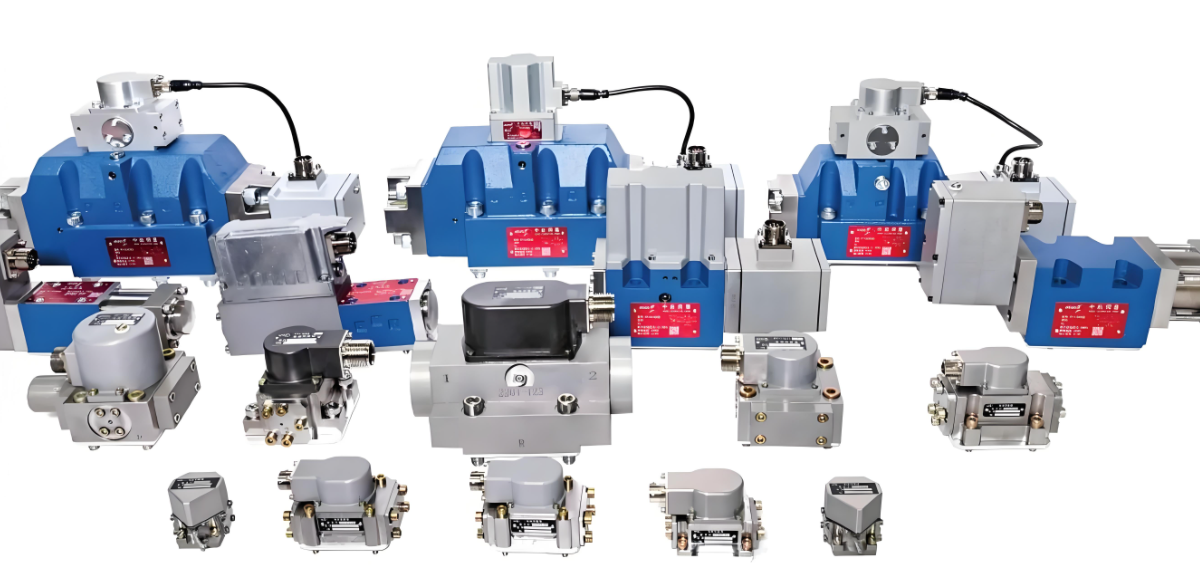
The ATOS position feedback servo valve is a high-performance hydraulic control component independently developed and produced by ATOS, an Italian leading manufacturer of fluid power and automation solutions. It integrates precise valve core control, real-time position detection and closed-loop regulation functions, belonging to the core executive unit in hydraulic servo systems. Unlike ordinary servo valves that only focus on flow or pressure control, this type of servo valve takes position as the core control target, which can dynamically adjust the valve core displacement according to the set position signal and feedback information, thereby realizing ultra-precise control of hydraulic actuators (such as hydraulic cylinders and hydraulic motors). It is widely used in scenarios requiring high positioning accuracy, fast response and stable operation, and forms a complete closed-loop control system with servo controllers, position sensors, hydraulic pumps and actuators to ensure the consistency and reliability of the output position, speed and force.
In addition to the basic characteristics of high precision, high response speed and long service life, the ATOS position feedback servo valve also has outstanding advantages such as strong anti-interference ability, good stability under extreme working conditions and excellent compatibility. Its internal core components are made of high-wear-resistant alloy materials and precision-machined through advanced CNC technology, which can resist the impact of high pressure, high temperature and impurity particles in the hydraulic system, and maintain stable performance even in harsh industrial environments such as strong vibration and large temperature fluctuations. At the same time, ATOS has optimized the structural design of the valve, reducing internal leakage and energy consumption, making it more in line with the development trend of energy-saving and environmental protection in modern industry.
Working Principle
The working principle of the ATOS position feedback servo valve is based on the closed-loop control mechanism of "signal input - valve core adjustment - feedback detection - signal correction", and its internal structure mainly includes an electrical conversion module, a valve core execution mechanism, a position feedback sensor and a pressure compensation component, which work together to achieve precise position control.
First, the servo controller sends a standard electrical signal (usually 0-10V voltage signal or 4-20mA current signal) to the electrical conversion module of the servo valve according to the set position parameter. This module converts the electrical signal into a mechanical driving force through electromagnetic induction or piezoelectric effect, pushing the valve core of the servo valve to move linearly or rotationally. The displacement of the valve core directly changes the opening size and direction of the valve port, thereby regulating the flow rate, pressure and flow direction of the hydraulic oil entering the actuator (hydraulic cylinder or hydraulic motor), and driving the actuator to move to the target position.
During the movement of the actuator, the built-in position feedback sensor (usually a linear variable differential transformer LVDT or a magnetostrictive sensor) of the servo valve will real-time detect the actual displacement of the valve core (which is positively correlated with the displacement of the actuator) and convert it into a corresponding electrical feedback signal. This feedback signal is transmitted back to the servo controller immediately, and the controller compares the feedback signal with the preset target signal to calculate the deviation value between the actual position and the target position.
According to the deviation value, the controller adjusts the output control signal through proportional-integral-derivative (PID) algorithm or fuzzy control algorithm, and dynamically corrects the movement of the valve core. If the actual position is less than the target position, the controller increases the driving signal to expand the valve port opening and increase the hydraulic oil flow rate, accelerating the movement of the actuator; if the actual position exceeds the target position, the controller reduces or reverses the driving signal to reduce the valve port opening or change the oil flow direction, decelerating or reversing the actuator. This cycle of detection, comparison and correction is carried out continuously at a high frequency (usually up to several hundred hertz), ensuring that the actuator can quickly and accurately reach and stabilize at the target position, and effectively suppressing the impact of external interference and system errors on the positioning accuracy.
Application Fields
Benefiting from its excellent control performance and stable working characteristics, the ATOS position feedback servo valve has been widely used in various high-end industrial automation fields, becoming a key component to improve equipment performance and process level. The specific application scenarios are expanded as follows:
1. Robotics Technology
In industrial robots (such as six-axis articulated robots, SCARA robots and collaborative robots), the ATOS position feedback servo valve is mainly used to control the hydraulic joints of the robot. Compared with electric joints, hydraulic joints have the advantages of large output force, high load-bearing capacity and strong impact resistance, which are suitable for heavy-duty operation scenarios such as automobile manufacturing, heavy machinery assembly and large component handling. The servo valve can realize micron-level precise control of the joint rotation angle and movement speed, ensuring that the robot's end effector (gripper, welding gun, spray gun) can accurately reach the set position. For example, in the automatic welding production line of automobile bodies, the servo valve controls the robot's welding arm to move along the preset trajectory with high precision, ensuring the uniformity of the weld seam and the firmness of the welding, and improving the qualification rate of automobile body assembly. In addition, in collaborative robots that require human-machine interaction, the servo valve's fast response and stable control performance can effectively avoid the robot's excessive movement speed or position deviation, ensuring the safety of human-machine collaboration.
2. Medical Equipment
In the field of medical equipment, the ATOS position feedback servo valve is widely used in high-precision medical devices that require strict position control, and its stability and accuracy are directly related to the safety and effectiveness of medical operations. In surgical robots (such as minimally invasive surgical robots and orthopedic surgical robots), the servo valve controls the movement of the surgical instrument arm, converting the doctor's operation instructions into precise mechanical movements, and realizing minimally invasive operations with small incisions, less bleeding and fast recovery. For example, in laparoscopic surgery, the servo valve can control the surgical forceps to perform fine operations such as clamping, cutting and suturing with a displacement error of less than 0.1mm, avoiding damage to surrounding tissues and organs. In addition, in medical imaging equipment such as CT scanners, nuclear magnetic resonance (MRI) machines and linear accelerators, the servo valve is used to control the position adjustment of the scanning bed and the imaging probe, ensuring that the patient's lesion area is accurately aligned with the scanning center, improving the clarity and accuracy of imaging, and providing reliable basis for clinical diagnosis and treatment.
3. Aerospace
The aerospace field has extremely strict requirements on the reliability, precision and environmental adaptability of components, and the ATOS position feedback servo valve has become an important component in aerospace equipment due to its excellent performance. In aircraft (manned aircraft, unmanned aerial vehicles and spacecraft), the servo valve is mainly used to control the attitude adjustment mechanism (such as ailerons, elevators, rudders) and landing gear systems. During the flight of the aircraft, the servo valve adjusts the deflection angle of the control surface in real time according to the signal from the flight control system, ensuring the stability of the aircraft's flight attitude, especially in complex weather conditions such as strong wind and turbulence, it can quickly respond to adjust and maintain the balance of the aircraft. In the landing gear system, the servo valve controls the extension and retraction speed and position of the landing gear, ensuring that the landing gear is accurately locked in place during takeoff and landing, and improving the safety of the aircraft's takeoff and landing. In addition, in spacecraft such as satellites and space stations, the servo valve is used to control the attitude control thrusters and solar panel adjustment mechanisms, ensuring that the spacecraft can maintain a stable orbit and attitude in space.
4. Precision Machinery Processing
In precision machining equipment such as CNC machine tools, machining centers and grinding machines, the ATOS position feedback servo valve is used to control the feed system and spindle drive system of the machine tool. The feed system's positioning accuracy directly affects the machining accuracy of the workpiece. The servo valve can realize high-precision control of the feed axis's movement, ensuring that the tool can move along the preset path with high precision, and processing workpieces with complex shapes and high precision requirements (such as precision molds, aerospace components and precision instruments). For example, in the grinding process of high-precision bearings, the servo valve controls the grinding wheel's feed amount and movement trajectory, ensuring the roundness and surface roughness of the bearing inner and outer rings meet the technical standards. At the same time, the servo valve's fast response performance can improve the feed speed of the machine tool, shorten the machining cycle and improve production efficiency.
5. Energy and Power Equipment
In the field of energy and power, the ATOS position feedback servo valve is widely used in hydropower, thermal power and new energy power generation equipment. In hydropower stations, the servo valve controls the opening of the water turbine guide vane, adjusting the water flow rate entering the water turbine according to the power grid load change, ensuring the stable output power of the water turbine. In thermal power plants, the servo valve is used to control the fuel supply system and steam valve, adjusting the fuel supply amount and steam flow rate in real time, ensuring the stable combustion of the boiler and the stable operation of the steam turbine. In new energy fields such as wind power and solar power, the servo valve is used to control the attitude adjustment of wind turbine blades and solar panels, ensuring that the wind turbine can capture wind energy to the maximum extent and the solar panel can be accurately aligned with the sun, improving the power generation efficiency of new energy equipment.
Conclusion and Future Trends
As a core component of modern hydraulic servo control systems, the ATOS position feedback servo valve plays an irreplaceable role in improving the automation level, precision and stability of industrial equipment. It not only promotes the upgrading and development of traditional industries such as machinery manufacturing, automobile production and energy power, but also provides strong technical support for the rapid development of emerging fields such as medical robots, aerospace and new energy. With the continuous advancement of industrial intelligence, digitalization and energy-saving requirements, the ATOS position feedback servo valve is also facing new development opportunities and technical challenges, and its future development trends are mainly reflected in the following aspects:
First, intelligence upgrading. In the future, ATOS will integrate more intelligent sensing components and communication modules into the servo valve, realizing real-time monitoring of the valve's working status (such as temperature, pressure, leakage and wear). Through the Industrial Internet of Things (IIoT) technology, the working data of the servo valve is transmitted to the cloud platform for analysis and early warning, realizing predictive maintenance of the servo valve, reducing the failure rate of the equipment and extending the service life of the valve.
Second, energy-saving optimization. With the increasing emphasis on energy conservation and environmental protection, ATOS will further optimize the structural design of the servo valve, adopt new materials and new processes to reduce internal leakage and energy consumption. At the same time, combined with intelligent control algorithms, the servo valve's control strategy is dynamically adjusted according to the working condition of the system, realizing the optimal matching of energy consumption and control performance, and meeting the energy-saving requirements of modern industrial systems.
Third, miniaturization and integration. In fields such as micro-robots, precision medical equipment and small aerospace devices, there is an increasing demand for miniaturized and integrated servo valves. ATOS will develop miniaturized position feedback servo valves through micro-machining technology and integrated design, while ensuring that the performance indicators such as precision and response speed are not reduced, to adapt to the development needs of miniaturized equipment.
Fourth, high-temperature and high-pressure resistance. With the expansion of application fields, the servo valve is required to work in more extreme environments such as high temperature, high pressure and strong corrosion. ATOS will develop servo valves with stronger environmental adaptability by improving the material performance, optimizing the sealing structure and enhancing the corrosion resistance of components, to meet the application needs of special fields such as deep-sea exploration, nuclear power and aerospace.
In summary, the ATOS position feedback servo valve, as a key component of industrial automation, will continue to develop in the direction of intelligence, energy-saving, miniaturization and high reliability. It will not only expand its application scope in more fields, but also make greater contributions to the transformation and upgrading of the global manufacturing industry and the development of intelligent technology.