
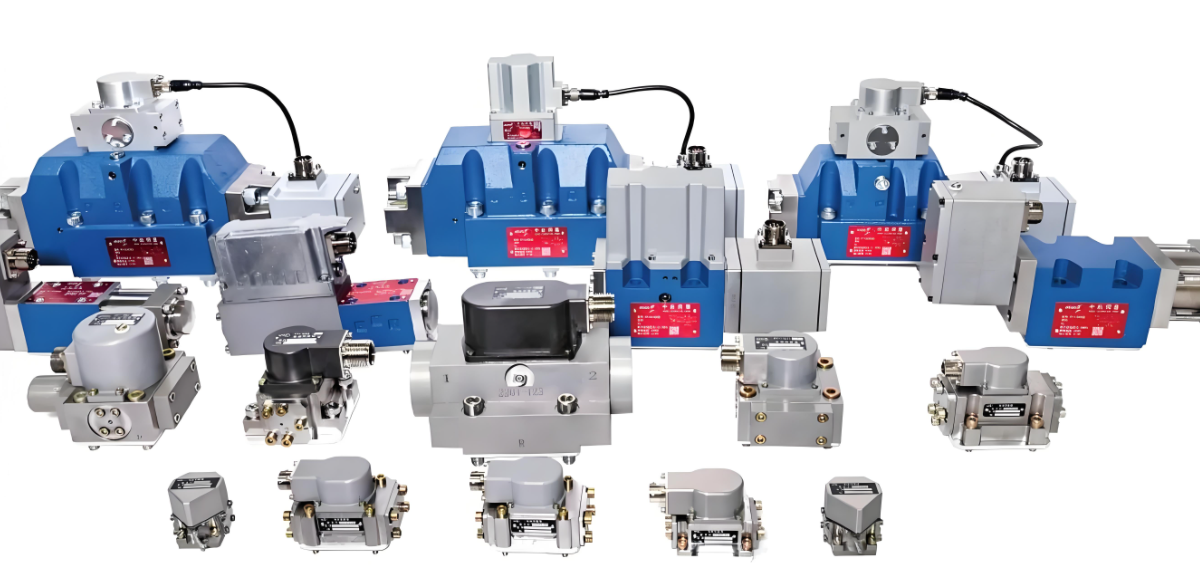
1、 Definition and classification of electro-hydraulic servo valve industry
The electro-hydraulic servo valve is an important control component in the electro-hydraulic servo control system. After receiving electrical analog signals, it outputs modulated flow and pressure accordingly. It is both an electro-hydraulic conversion component and a power amplification component, capable of converting low-power weak electrical input signals into high-power hydraulic energy (flow and pressure) output. Electro hydraulic servo valves can be divided into proportional electro-hydraulic servo valves, digital electro-hydraulic servo valves, pressure and flow control valves, and directional control valves according to their functional characteristics; According to the working principle, it can be divided into electric servo valves and hydraulic servo valves; According to the valve core structure, it can be divided into screw type electro-hydraulic servo valves and valve type electro-hydraulic servo valves; According to product type and technology, it can be divided into nozzle baffle type, jet tube type, and direct drive type. Among them, the nozzle baffle type electro-hydraulic servo valve is the most widely used product.
2、 The current situation of the global electro-hydraulic servo valve industry
The application field of electro-hydraulic servo valves is extensive. With the development of downstream industries, the global market size of electro-hydraulic servo valves is gradually expanding, from 1.281 billion US dollars in 2017 to 1.618 billion US dollars in 2022, and about 1.703 billion US dollars in 2023. With the continuous development of industries such as aerospace and petrochemicals, the global electro-hydraulic servo valve market will further grow, and it is expected that the global electro-hydraulic servo valve market size will reach 1.794 billion US dollars by 2024.
Due to limitations in technology and research and development capabilities, the global production capacity of high-end electro-hydraulic servo valves is mainly concentrated in regions such as the United States, Germany, and Italy. Related suppliers include MOOG from the United States, Bosch Rexroth from Germany, Parker from the United States, and Honeywell from the United States. Data shows that in 2023, the North American electro-hydraulic servo valve market will account for 42.16% of the global market size; The European electro-hydraulic servo valve market accounts for 26.19%; The market size of electro-hydraulic servo valves in the Asia Pacific region accounts for 25.72%. It is expected that by 2024, the North American electro-hydraulic servo valve market will account for 41.97% of the global market size; The European electro-hydraulic servo valve market accounts for 25.92%; The market share of electro-hydraulic servo valves in the Asia Pacific region is 26.09%.
3、 Development status of domestic electro-hydraulic servo valve industry
With the continuous enhancement of China's comprehensive national strength, the continuous progress of scientific and technological level, and the continuous development of high-end manufacturing industry, the demand for electro-hydraulic servo valve market continues to grow. Meanwhile, with the continuous expansion of domestic enterprise production capacity, the output of the domestic electro-hydraulic servo valve industry continues to grow. According to statistics, the market demand for China's electro-hydraulic servo valve industry will increase from 33500 sets in 2017 to 61300 sets in 2023, and the production will increase from 27100 sets in 2017 to 51000 sets. It is expected that the market demand for China's electro-hydraulic servo valve industry will reach 67900 sets by 2024, and the output is expected to reach 56700 sets.
With the rapid growth of demand for electro-hydraulic servo valves in China, the market size is also showing a trend of rapid growth. In 2017, the demand for electro-hydraulic servo valves in China was 852 million yuan, and by 2023, the market size will reach 1.36 billion yuan. It is expected to reach 1.48 billion yuan by 2024.