
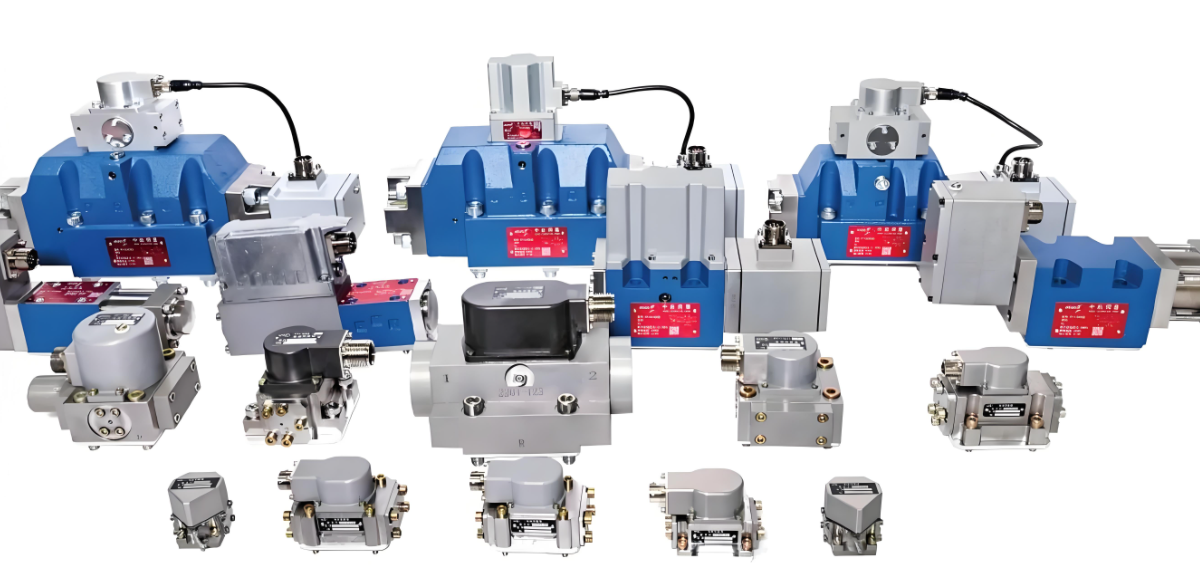
1. The Working Principle of Servo Valve
Servo valves are high-precision feedback control components that act as the "core actuator" in CNC (Computer Numerical Control) systems, converting electrical signals from the CNC controller into precise mechanical motion to regulate fluid power. Unlike ordinary on-off valves, servo valves feature closed-loop feedback mechanisms, which enable them to achieve ultra-high control accuracy and stability. Structurally, servo valves are more sophisticated than the basic composition of electromagnets and valve bodies mentioned; a typical electro-hydraulic servo valve, for example, consists of a torque motor (electromagnetic component), a nozzle-flapper mechanism (amplification component), a spool valve (main control component), and a feedback rod (feedback component).
When an electrical signal (usually a current signal of 4-20mA or a voltage signal of ±5V) is input from the CNC system, the torque motor generates a corresponding magnetic torque, which drives the flapper to deflect slightly. This deflection changes the gap between the flapper and the two nozzles, resulting in a pressure difference in the control chamber connected to the nozzles. The pressure difference pushes the spool of the main valve to move, thereby adjusting the opening size of the valve port. The opening degree directly determines the flow rate and direction of hydraulic oil (or other fluids/gases) passing through the valve. Meanwhile, the feedback rod connects the spool to the flapper, forming a closed-loop control: when the spool moves to a position corresponding to the input electrical signal, the feedback force balances the magnetic torque of the torque motor, and the flapper returns to a stable state, ensuring that the valve port opening remains consistent with the instruction. This dynamic balance process realizes the precise conversion of electrical signals to fluid flow, and further controls the movement speed, position, and force of the actuator (such as the feed axis of a CNC machine tool).
2. The Function of Feed Axis Positioning Servo Valve
In CNC machine tools, the feed axis positioning servo valve is a key component linking the CNC control system and the mechanical execution mechanism, and its core function is to realize the precise positioning and motion control of the feed axis (which drives the tool or workpiece to move). In the machining process, the CNC system calculates the required movement trajectory and position of the feed axis based on the part program, and transmits the corresponding electrical signals to the servo valve. The servo valve adjusts the flow rate and direction of the hydraulic oil according to the signal, driving the hydraulic cylinder or hydraulic motor of the feed axis to operate, so that the tool or workpiece can accurately reach the specified machining position.
Beyond basic positioning, this servo valve also undertakes multiple critical functions to optimize machining performance. First, it enables stepless adjustment of feed speed: according to different machining processes (such as rough machining, semi-finishing, and finishing) and material characteristics (such as hardness of metal materials), the servo valve can dynamically adjust the fluid flow rate, thereby changing the feed speed of the axis—high speed for rough machining to improve efficiency, and low speed for finishing to ensure precision. Second, it realizes smooth motion control: by precisely regulating the valve port opening and avoiding sudden changes in flow rate, the servo valve reduces the impact and vibration of the feed axis during startup, acceleration, deceleration, and stop, ensuring stable motion of the tool/workpiece. Third, it cooperates with position sensors (such as linear graters) to achieve closed-loop position correction: if the sensor detects a deviation between the actual position of the feed axis and the theoretical position, the CNC system will adjust the electrical signal input to the servo valve in real time, correcting the deviation and ensuring machining accuracy.
3. The Importance of Feed Axis Positioning Servo Valve
As a core control component of CNC machine tools, the feed axis positioning servo valve directly determines the machining quality, production efficiency, and operational stability of the equipment, and its importance is reflected in the following aspects:
3.1 Precision Guarantee
High-precision machining is the core demand of industries such as aerospace, precision instrumentation, and auto parts. The servo valve’s ability to respond to micro-signals and control the spool displacement with micron-level accuracy enables the feed axis to achieve positioning accuracy of 0.001mm or even higher. For example, in the machining of aerospace engine blades, the complex curved surface requires the feed axis to move along a precise trajectory, and the servo valve’s precise control ensures that each cutting point of the tool is consistent with the design parameters, avoiding machining errors that may lead to product scrapping.
3.2 Operational Stability
During long-term continuous machining, the stability of the feed axis directly affects the surface quality of the workpiece and the service life of the equipment. The closed-loop feedback mechanism of the servo valve can automatically compensate for external disturbances (such as voltage fluctuations, changes in oil temperature, and mechanical friction) and internal parameter drifts, maintaining the stability of the valve port opening and fluid flow rate. This reduces vibration and noise during machining, avoids chatter marks on the workpiece surface, and also reduces wear of mechanical components such as guide rails and screws, extending the service life of the machine tool.
3.3 Rapid Response Capability
In high-speed machining and complex trajectory machining, the feed axis needs to quickly respond to the CNC system’s instruction changes (such as direction switching and speed adjustment). The servo valve’s torque motor and nozzle-flapper mechanism have ultra-fast response characteristics, with a response time usually in the millisecond level. This enables the feed axis to complete rapid positioning and trajectory switching, shortens the machining cycle, and improves production efficiency. For example, in the machining of complex mold cavities, the servo valve’s rapid response ensures that the tool can smoothly follow the complex curve trajectory without lag, improving machining efficiency and surface finish.
3.4 Maintainability and Operational Continuity
Modern servo valve designs fully consider maintenance convenience, adopting modular structures and standardized interfaces. Key components such as torque motors and spools can be quickly disassembled, inspected, and replaced, reducing maintenance difficulty and time. In addition, many high-end servo valves are equipped with status monitoring functions, which can real-time feed back parameters such as internal pressure, temperature, and spool position to the CNC system. This enables early warning of potential faults (such as wear of the valve core and blockage of the nozzle), allowing maintenance personnel to handle them in advance, avoiding sudden equipment shutdowns and reducing production losses caused by downtime.
4. Conclusion
The feed axis positioning servo valve is an indispensable core component in modern CNC machine tools, and its performance directly determines the technical level of the machine tool. Through the precise conversion of electrical signals to fluid power and the closed-loop feedback control mechanism, it provides a reliable guarantee for the high precision, stability, and efficiency of CNC machining. With the rapid development of intelligent manufacturing, industrial Internet of Things, and digital twins, the development of servo valves is also moving towards higher precision, faster response, intelligence, and integration.
In the future, servo valves will be integrated with more advanced sensor technologies (such as optical sensors and pressure sensors) to realize real-time monitoring and self-diagnosis of full-life cycle status; at the same time, with the application of digital control algorithms (such as fuzzy control and adaptive control), servo valves will have stronger adaptive capacity to complex working conditions, automatically adjusting control parameters according to changes in machining processes and materials. In addition, the development of energy-saving technologies will promote the optimization of servo valve structures, reducing energy consumption while ensuring performance. As an important part of the intelligent manufacturing chain, the feed axis positioning servo valve will play a more critical role in promoting the transformation and upgrading of the manufacturing industry, helping to achieve more efficient, precise, and intelligent machining production.